
A client issue comes up, so you solve it. A team member needs clarity, so you provide it. A project stalls, so you step in and get it moving again. A decision sits too long, so you make the call because everyone is waiting and the work needs to move.
None of those moments feel like a design problem at first. They feel like leadership, responsibility, and the normal work of running a growing business with clients to serve, people to lead, and standards to protect. That is why the pattern can continue for so long.
A founder can spend months solving the same kind of problem without realizing the business is asking a different question. Not, “Can you fix this?” The real question is, “Why does this keep needing you?” That is the line between reaction and design.
Reaction answers what is loudest right now. Design looks at why the same issue keeps returning. Reaction protects the moment. Design protects the business. Reaction often feels faster because the founder already knows what to do. Design requires enough space to see what the business has been depending on that it should have outgrown by now.
Most founders do not stay reactive because they are careless. They stay reactive because reaction works. In the early stages, responsiveness is often the reason the business survives and grows. The founder remembers the client history, protects the standard, reads the nuance in a situation, and makes judgment calls before anyone else even sees the gap. They know which decisions carry risk, which ones can move quickly, and where the business has room to be flexible.
That closeness can be a gift in the beginning. It builds trust. It protects quality. It helps the business move quickly before much structure exists. At a certain stage, the same closeness starts creating dependency.
The business may look healthy from the outside. Clients are being served. Projects are moving. Meetings are happening. The team is working hard and genuinely wants to do good work. Still, too many things come back to the founder for interpretation, approval, correction, or final direction. The founder may not be doing every task, yet their judgment is still holding too much of the business together.
That is the hidden cost of staying reactive. The business keeps moving, while the founder becomes the place where uncertainty gets resolved. A team member waits because they want to make the right decision. A project owner has responsibility, yet not enough authority to move through the gray area. A client question gets escalated because the context lives mostly in the founder’s head. A deliverable comes back close, just not quite aligned with the standard. A meeting feels clear in the moment, then follow-up questions reveal that people left with slightly different interpretations of what was actually decided.
Each issue can be handled, and that is part of the problem. Because each issue can be handled, the founder keeps handling it. They answer the question, fix the communication, adjust the deliverable, clarify the expectation, and move on. The business gets through the week. Clients are served. Nothing looks urgent enough to stop and redesign.
Then the same pattern shows up again with a different name. This week it looks like a client issue. Next week it looks like a team issue. Then it looks like a project issue, a communication issue, a scheduling issue, or a quality issue. The surface changes, which makes the pattern harder to see. Underneath, the business keeps revealing the same thing: something has not been designed clearly enough to move without the founder’s involvement.
That is where the founder’s next level of leadership begins. Not with more effort, a tighter calendar, or another attempt to be more disciplined, more available, or more responsive. The founder has already proven they can respond. The real work is deciding which parts of the business should no longer require that level of response.
Design starts with a different kind of question. Instead of asking, “How do I fix this quickly?” the founder starts asking, “Why did this need me in the first place?” Instead of asking, “Who dropped the ball?” they look at whether ownership was clear enough to hold. Instead of wondering why the team keeps circling back, they consider whether the standards, decision rights, and context were strong enough for the work to move without returning for interpretation.
That shift matters because reactive problem-solving usually focuses on the incident. Intentional design focuses on the operating pattern. If a client keeps escalating, the question is not only how to handle that client well today. The deeper question is whether the client experience has been designed clearly enough for the team to protect it without founder intervention.
If work keeps coming back close, yet not complete, the issue may not be effort. The standard may still be living in the founder’s head instead of in language, examples, and ownership the team can use. If decisions keep waiting for the founder, speed is not the only concern. The business may not have clearly defined who owns which decisions, what authority they carry, and when something truly needs escalation.
This is where effort can start to hide the real issue. For a founder-led business, the goal is not to care less, lower the standard, or become less available just for the sake of it. The goal is to stop using the founder’s personal capacity to compensate for a structure that needs to mature.
A reactive business can be full of hardworking people. It can have a founder who cares deeply, a team that wants to do well, and clients who are being served. It can also be quietly dependent on the founder’s constant availability to keep things clear. That is not a character flaw. It is an operating design.
Every business has one. Some are intentional. Some are inherited from the early years. Some are built around the founder’s memory, instincts, preferences, and ability to make quick judgment calls under pressure. The design may not have been chosen on purpose, yet the business will keep behaving according to the structure that exists.
If the fastest way to get clarity is to ask the founder, people will ask the founder. If the safest way to protect quality is to wait for approval, people will wait. If ownership is assigned without decision rights, decisions will return. If standards are understood by feel rather than clearly expressed, work will come back for interpretation. The business repeats what the structure quietly rewards.
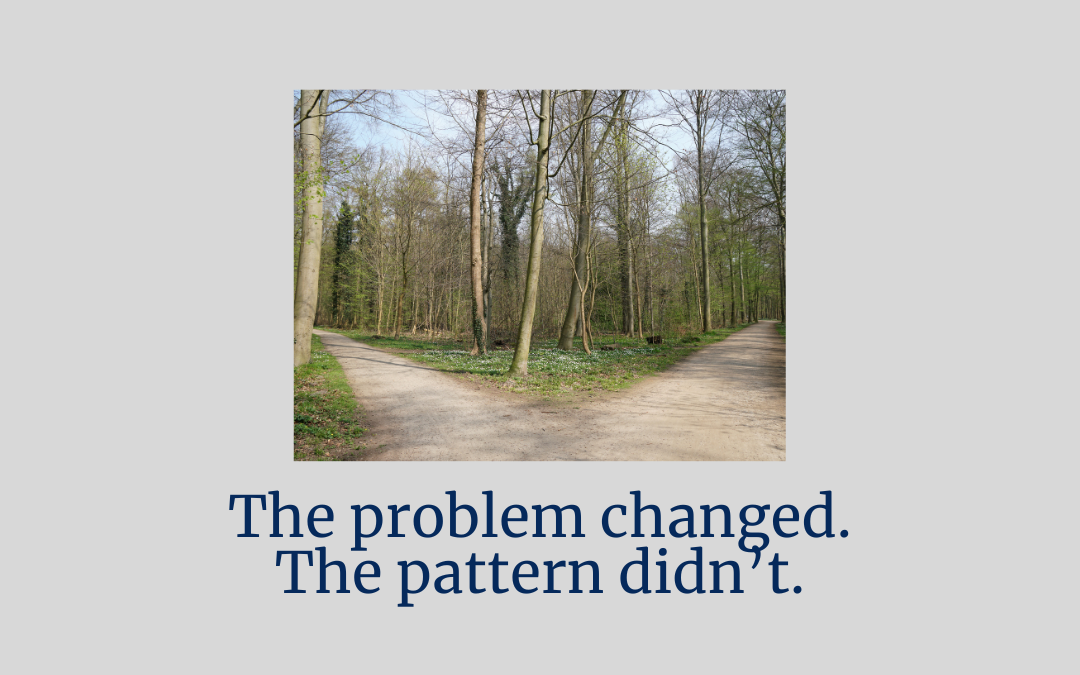
That is why the fork in the road matters. One path keeps the founder in reaction. Each issue gets solved as it appears. The unclear moments get smoothed over. The founder remains the final checkpoint, the pressure release, and the person responsible for carrying whatever has not been fully designed into the business. In the short term, that path can feel efficient because the founder is skilled, fast, and deeply familiar with how things should work. Over time, it keeps the business dependent in ways that become harder to sustain.
The other path requires stepping back to design the business more intentionally. That means looking at where work returns, where decisions stall, where ownership is soft, where standards are implied, and where the team still needs the founder to interpret what matters. It means shifting the business from “come back to me when you are unsure” to “here is how we make decisions, protect standards, and carry ownership here.”
That is a different kind of leadership. It is quieter than constant response. It is less visible than jumping in to fix the issue. It may not create the immediate satisfaction of clearing the problem in front of you. It does, however, build a business that can hold more weight without making the founder the answer to every unclear moment.
That is what design does. Design does not remove the founder’s judgment from the business. It translates that judgment into structure. It gives the team a way to move with clarity. It defines how decisions are made, what ownership actually means, what standards need to be protected, and when escalation is appropriate. It allows the business to mature beyond the founder’s constant proximity.
This is the difference between a business that keeps reacting and a business that is being intentionally built. A reactive business waits for the founder to resolve the unclear parts. A designed business gives people enough clarity to carry responsibility well. A reactive business may keep moving, yet the movement depends heavily on the founder’s presence. A designed business can move with more confidence because ownership, standards, and decision paths are not living only in the founder’s head.
For many founders, the uncomfortable truth is that the business is not asking them to work harder. It is asking them to stop solving what needs to be designed. That does not mean every problem disappears or that the founder is never needed. It means recurring issues become information. They become signals that something in the business needs a clearer path, a stronger owner, a better standard, or a more mature way of making decisions.
The client issue is not just a client issue. The team’s hesitation is not just hesitation. The project that keeps coming back is not just a project problem. The decision that waits too long is not just a delay. Each one may be pointing to the same deeper question: Is the business designed to carry this level of growth, or is it still relying on the founder to react their way through it?
That is the August question. Not because the year is falling apart. Not because the founder has failed. Because by this point in the year, the pattern is usually visible. The same issues have had enough time to repeat. The same decisions have had enough time to return. The same pressure points have had enough time to prove they are not isolated events.
The founder can keep reacting to each one as it appears. Or they can step back and design this properly.
If this feels familiar, a Gateway Clarity Call is a good place to talk it through.
Recent Comments